
Tax-free cash: the pension's party trick
Pensions have a reputation for being about as exciting as a beige cardigan. But they have one genuine party trick: part of the money comes out tax-free. This guide explains how that works, without the jargon, and with only a small amount of cardigan.
(It covers "defined contribution" pensions, the kind where you build up a pot. Final salary schemes have their own rules.)
The headline
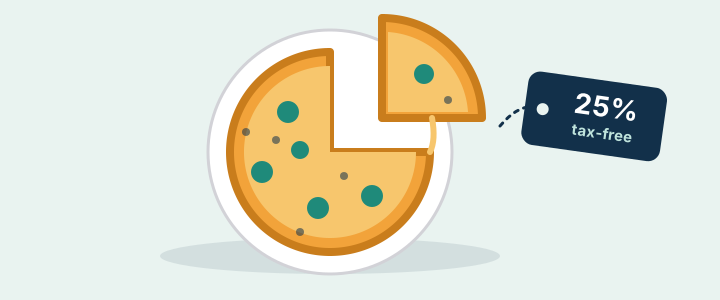
You can usually take up to 25% of a pension tax-free. The other three-quarters is taxed as income when it comes out. Think of it as a pizza where one slice in four is free and the rest go on the tab.
There is, naturally, a limit, because this is still a tax system. The lump sum allowance caps the tax-free total across all your pensions at £268,275. A quarter of a pot only bumps into that ceiling at about £1,073,100, so for most people the rule is simply "a quarter".
The cap is fixed in pounds and doesn't rise with prices. Each year it quietly buys a bit less, like a chocolate bar that keeps shrinking but costs the same.
You can usually get at it from age 55, rising to 57 from 6 April 2028. Some schemes have a protected earlier age, tucked away in the small print (yes, really).
Two ways to take it
The big reveal: all at once
You take the full 25% as one lump sum. The rest stays invested, usually in drawdown, and anything you take from it later counts as taxable income.
Worked example: All at once
A pot of £200,000.
- Tax-free lump sum: 25% × £200,000 = £50,000
- Left invested: £150,000, taxable whenever it comes out
People use lump sums for all sorts: paying off a mortgage, a new kitchen, helping the kids, a trip they've been promising themselves since 1997. One thing to know: money that leaves the pension and sits in a current account stops enjoying the pension's tax-free growth. It's swapped a greenhouse for a windowsill.
The slow drip: bit by bit
Or you leave the pot alone and take money as and when. Each withdrawal is usually 25% tax-free and the rest taxable: the pizza rule again, one slice at a time. Providers call these "uncrystallised funds pension lump sums", a phrase clearly invented by someone who has never had to say it out loud.
Worked example: Bit by bit
Taking £20,000 from an untouched pot in one year:
- Tax-free part: 25% × £20,000 = £5,000
- Taxable part: £15,000, added to your other income
With no other income that year, the £15,000 fits inside the £12,570 Personal Allowance, so tax on it is £486. Once the State Pension starts it fills most of that allowance, and the taxable part starts to attract tax.
If the pot never changed in value, both routes would hand you the same total tax-free amount. Real pots wobble, so with the slow drip your tax-free slices grow or shrink with the investments.
The small print, minus the squinting
Paying into pensions afterwards
Taking only your tax-free cash doesn't affect how much you can keep paying into pensions. But once you take taxable money flexibly (including the taxable part of a bit-by-bit withdrawal), the money purchase annual allowance kicks in, and tax-relieved payments into defined contribution pensions are limited to £10,000 a year. Mostly relevant if you're still working and saving.
The emergency tax surprise
The first taxable payment is often taxed on an emergency tax code, which can take far too much. It's not personal; the system just panics. You can claim it back from HMRC, or it gets sorted out later in the tax year.
Benefits
A large pile of cash in the bank can affect means-tested benefits. Pension Wise can explain how that works.
When you're gone
Pensions are treated differently from other savings when someone dies, and the rules are due to change from April 2027, when most unused pension money is planned to come into inheritance tax. The calculator doesn't model inheritance tax.
Small pots
A pension worth £10,000 or less can often be taken in one go, with a quarter tax-free and the rest taxed as income. Handy for those forgotten workplace pots from the job with the terrible coffee machine.
Try it in the calculator
The calculator models both routes. Upfront tax-free cash goes into an ISA up to the yearly allowance (£20,000); the rest waits as cash and moves across in later years. Flip between them and watch what changes:
The short version
A quarter of your pension usually comes out tax-free, up to £268,275 in total. You can take it in one go or in slices. Taking taxable money flexibly caps future pension saving at £10,000 a year. For free, impartial guidance, people aged 50 or over with a defined contribution pension can book Pension Wise.
Sources
- GOV.UK, Tax on your private pension: what's tax-free
- GOV.UK, Lump sum allowance
- GOV.UK, Annual allowance
- GOV.UK, Claim a tax refund on a pension