
Retiring early: mind the gap (the bridge years)
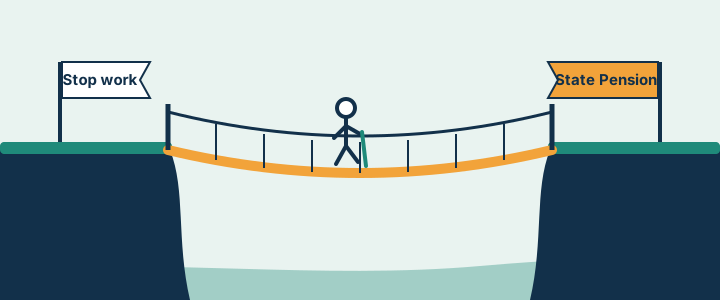
Retiring early sounds wonderful. Long walks. Long lunches. Long, smug looks at people stuck in traffic on a Tuesday morning. But there's a stretch of retirement that does a surprising amount of the heavy lifting, and it has a name: the bridge years.
What are the bridge years?
They're the years between when you stop work and when your State Pension starts. The State Pension can't be taken before State Pension age, which is 66 now and rising to 67 for people born from 6 March 1961 (with a staggered rise for those born just before). See our State Pension guide for the full timetable.
So if you stop work at 60 and your State Pension starts at 67, that's a seven-year bridge. Your own savings carry the whole load until the State Pension arrives to help.
Why they matter so much
The full new State Pension is £241.30 a week, about £12,548 a year. Before it starts, every pound of spending comes out of your pots. After it starts, the State Pension covers a big chunk and your pots only fill the gap.
Worked example: A seven-year bridge
Someone stops work at 60, with a State Pension starting at 67, and wants £20,000 a year (in today's money, ignoring tax to keep it simple).
- Ages 60 to 66: all £20,000 comes from savings. Over seven years, that's £140,000.
- From 67: the full State Pension covers about £12,548, so savings only need to find about £7,500 a year.
The pot works hardest at the very start, which is also when a market wobble can sting the most.
Today’s money, ignoring tax and investment growth, with a full State Pension from 67.
That's why the bridge years often decide whether a pot lasts. It's not the decades of gentle sipping later on; it's the early gulps.
Your private pension has its own clock
Private and workplace pensions have a minimum age too, separate from the State Pension. It's 55 now, rising to 57 from 6 April 2028. Some schemes have a protected lower age.
If you're aged 55 or 56 when that change happens, you may find your pension is out of reach again until 57. It's like being told the party's started, then the bouncer changes the rules. The calculator checks this from your date of birth.
So an early retiree may have two gaps to think about:
- Before your private pension opens: savings outside pensions (ISAs, cash, other investments) are the only things you can spend.
- Before your State Pension starts: private pensions and other savings carry everything.
The tax side (good news, for once)
Here's the cheerful bit. In the bridge years, many people have little or no other taxable income. That means the Personal Allowance, the first £12,570 of income each year that's usually tax-free, has plenty of room.
Worked example: Pension income in a bridge year
With no other income, taking £12,000 of taxable pension income in a year:
- Income tax: £0, because it all fits inside the Personal Allowance
Once a full State Pension starts, it uses about £12,548 of that allowance on its own, leaving very little room. The same £12,000 of pension income on top would then cost £2,396 in income tax.
On top of that, a quarter of each withdrawal can usually be tax-free, as explained in our guide to tax-free cash. The calculator's standard drawdown order uses this: it fills the Personal Allowance with pension income each year before reaching for other savings.
Other things that build bridges
- Part-time work. Even modest earnings in the early years mean less drawn from savings when the pot is most exposed.
- A final salary pension that starts before State Pension age shortens the bridge.
- Savings outside pensions (ISAs and cash) can be spent at any age and are tax-free (ISAs) or lightly taxed (cash interest).
- Spending that varies. Many people spend more in their early, active years. That's lovely, and it also makes the bridge longer. See why spending often falls with age.
None of these is right or wrong. They're levers, and the calculator lets you pull them to see what moves.
Try it in the calculator
See the bridge for yourself. The pots chart shades the years between retiring and the State Pension:
Notice how the income chart steps up when the State Pension arrives, and how the pots chart dips most steeply during the bridge.
The short version
The bridge years run from when you stop work until your State Pension starts. Your savings do all the work during them, so they often decide how long a pot lasts. Private pensions have their own minimum age, 57 from 2028, which can create a second gap. On the bright side, the bridge years often have spare Personal Allowance, so pension income can come out with little or no tax.
For free, impartial guidance, there's MoneyHelper and, if you're 50 or over with a defined contribution pension, Pension Wise.